

What every Spanish company needs to know to protect itself
They recorded a weekly average of cyberattacks far exceeding that of just two years ago, and the last quarter of 2026 closed with record numbers of reported cyberattack victims. Added to this is a fact that has completely changed the landscape: according to Deloitte, artificial intelligence has become the primary concern declared by information security professionals, even surpassing supplier management and regulatory compliance.
In this article we review the cybersecurity threats that will mark 2027 and the key strategies that Spanish companies must adopt to protect themselves.
1. Ransomware: the threat that keeps evolving
Ransomware continues to be the most critical risk for organizations of all sizes, year after year. This type of attack locks or encrypts a company's computer systems and demands a ransom in exchange for restoring access.
What has changed is not so much the volume as the sophistication: attacks are increasingly selective and targeted, with a particular focus on critical sectors such as healthcare, industry, logistics, and public administration. The time between initial access and system encryption has been significantly reduced in recent years, making early detection more difficult and forcing companies to strengthen their response capabilities.
The consequences remain the same as always, only more costly:
- Stoppage of operations.
- Leakage of sensitive data and double extortion (encryption plus publication of stolen data).
- Lasting reputational damage.
- Financial penalties if notification obligations are not met.
Therefore, having isolated and encrypted backups, along with a proven incident response plan, remains the foundation of any defense strategy.
2. Phishing and digital fraud powered by artificial intelligence
Phishing remains the most common entry vector for cybercriminals, but by 2027 its form has changed radically. The widespread adoption of generative AI allows for the creation of multilingual, personalized phishing campaigns that are virtually indistinguishable from legitimate communications, even to experienced users.
Among the fastest growing categories are:
- AI-generated emails and messages that accurately mimic suppliers, customers, or executives.
- Voice and video deepfakes used to impersonate organization officials and authorize fraudulent transfers in real time.
- Large-scale automation of fraud campaigns, which drastically reduces the technical barrier to entry for attackers.
Ongoing employee training and the implementation of phishing-resistant multi-factor authentication at critical access points remain the measures with the best return on investment against these types of threats.
3. Vulnerabilities in connected devices (IoT)
The sustained growth of the Internet of Things has multiplied the number of connected devices in the business environment: sensors, cameras, industrial machinery, or intelligent building systems.
Many of these devices still lack sufficient security measures, making them a common entry point for attackers, who use them to access internal networks, build botnets, or disrupt entire industrial and logistical processes.
Regular security audits and segmentation of corporate networks are, nowadays, essential and not optional practices.
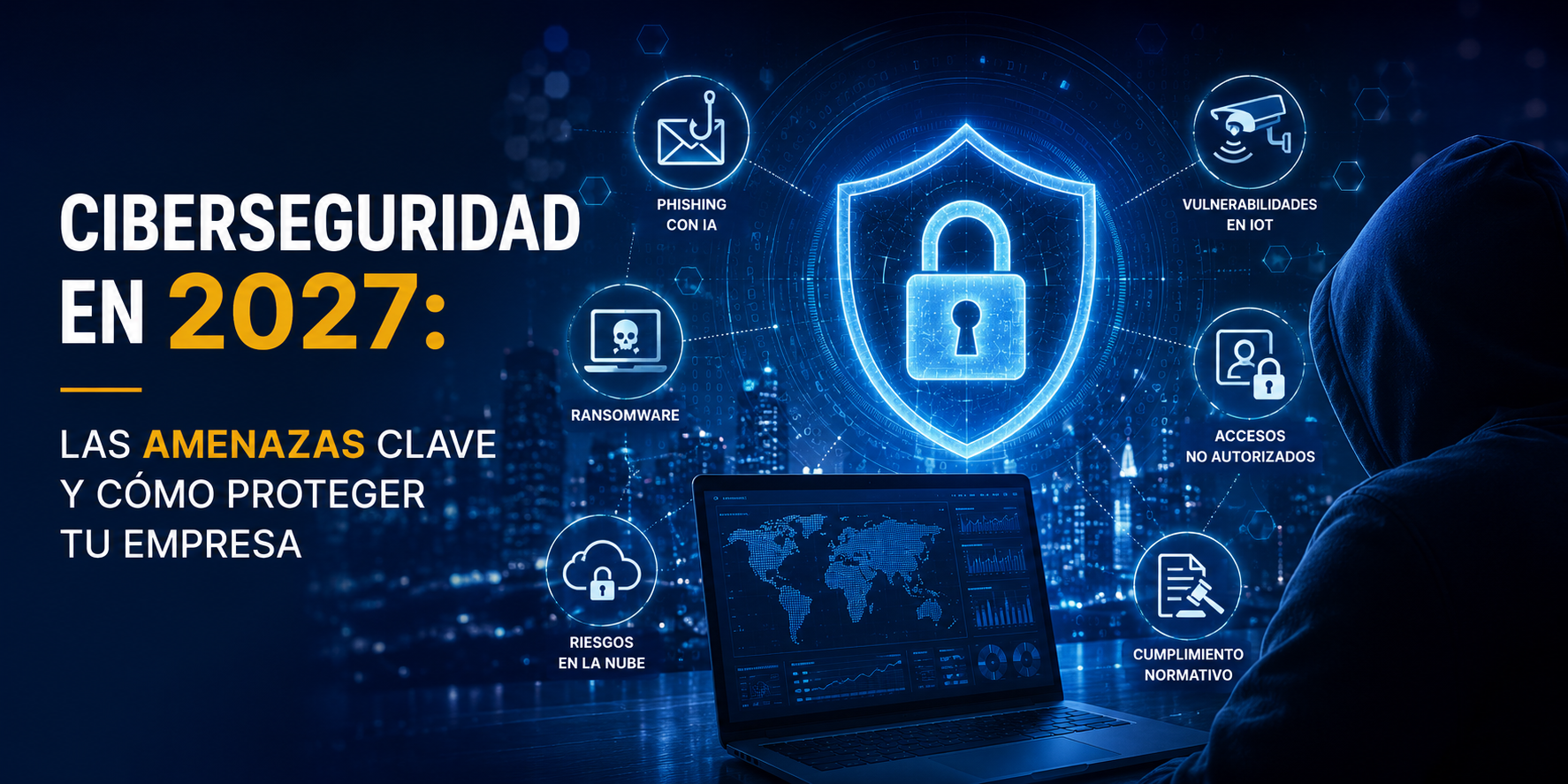
4. Risks in cloud, multicloud and remote work environments
Cloud migration has brought enormous operational advantages, but it has also introduced new risks that have become more complex with the expansion of multicloud and SaaS environments. Incorrect configurations, unauthorized access by internal or third-party users, and reduced visibility into where the organization's data actually resides are now among the main headaches for security teams.
Added to this is a relatively new risk: the corporate use of generative AI tools can lead to the accidental leakage of sensitive information when employees enter confidential data into these platforms without adequate controls.
A robust strategy must include access control under the principle of least privilege, data encryption, and continuous monitoring of both internal systems and AI tools used by staff.
5. Regulatory compliance: from obligation to competitive advantage
Cybersecurity regulations continue to grow at the same pace as the threats themselves. In Europe, the Cyber Resilience Act mandates security requirements for digital products throughout their entire lifecycle, while the NIS2 Directive obliges a growing number of critical and essential entities to report incidents within very tight timeframes.
Spanish companies should continue to pay attention to:
- The General Data Protection Regulation (GDPR) and the Organic Law on Data Protection and Guarantee of Digital Rights (LOPDGDD).
- The NIS2 Directive on network and information security.
- The DORA Regulation, which is mandatory for entities in the financial and insurance sectors.
Non-compliance not only entails significant financial penalties: it also represents a loss of trust that is difficult to regain with customers, partners and investors.
How can companies prepare for 2027?
Addressing this situation requires a comprehensive strategy based on three pillars: prevention, detection, and response. Among the measures most recommended by leading industry reports are:
- Implement multi-factor authentication on all critical access points.
- Keep systems and software permanently updated.
- Perform regular, encrypted backups isolated from the main network.
- Provide ongoing training to employees, including phishing and social engineering drills using AI.
- Establish and rehearse an incident response plan.
- Audit suppliers and the entire digital supply chain.
Cybersecurity has ceased to be an exclusively technological issue and has become a central element of business strategy and risk management.
Conclusion
The cybersecurity landscape in 2027 will most likely be more complex and automated than in previous years. Attacks will be more targeted, increasingly reliant on artificial intelligence, and more difficult to detect with traditional tools.
Companies that want to protect their information, reputation, and business continuity must anticipate threats and build a genuine digital security culture throughout the organization. Investing in cybersecurity not only reduces risks but also strengthens the trust of customers, partners, and employees in an increasingly demanding environment.
That's precisely why the demand for cybersecurity professionals continues to grow. At EIP International Business School, we train the future leaders of this transformation through our Master in Cybersecurity, designed together with the sector to respond to the challenges that Spanish companies will face in the coming years.
Employment Team, EIP International Business School
If you want to lead this transformation within your company, discover the Master's Degree in Cybersecurity from EIP and train with the most in-demand profile in today's job market.
You can find more details about the current state of threats in the Check Point Software Security Report 2026, one of the most cited references in the sector.